AI replacing support teams for SaaS
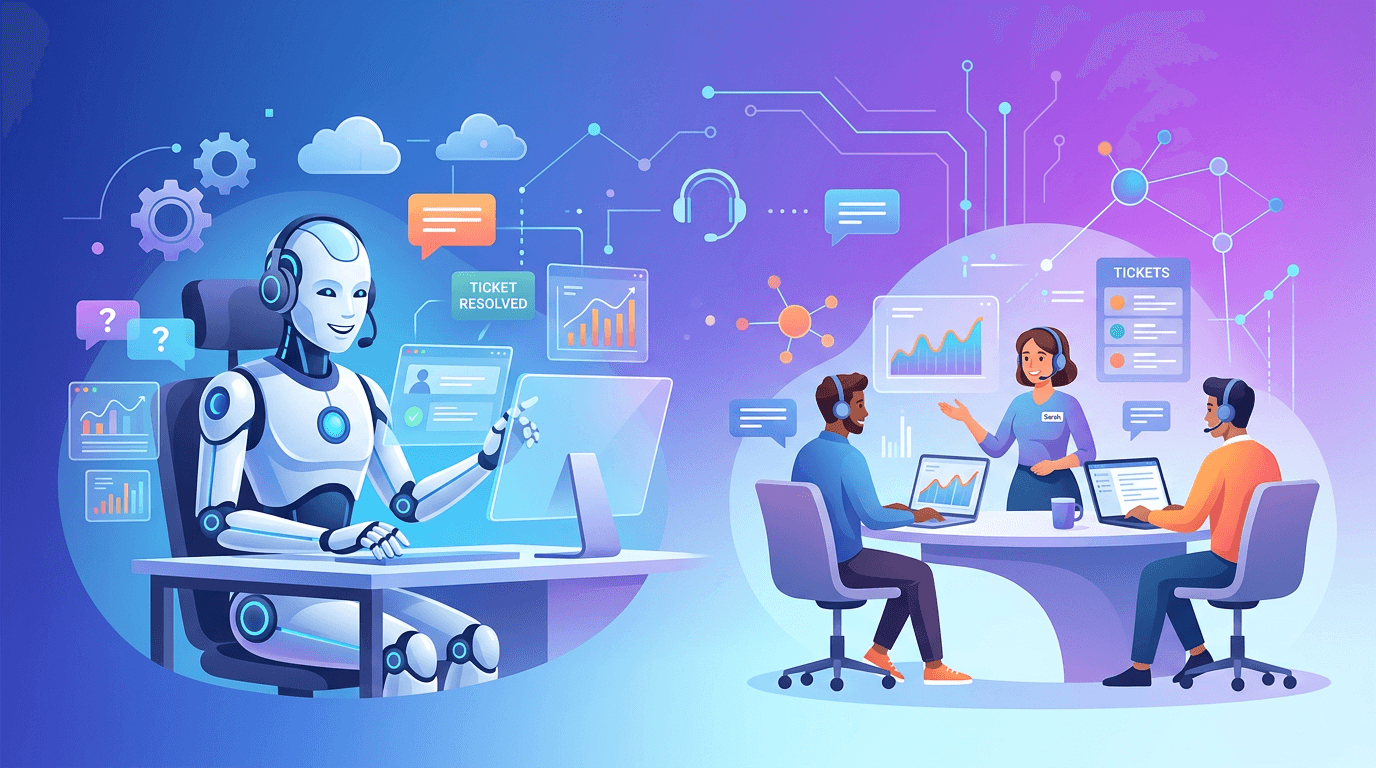
The AI-Driven Transformation of SaaS Customer Support
The software-as-a-service (SaaS) ecosystem is currently navigating a fundamental restructuring of its customer engagement and support methodologies. Driven by exponential advancements in generative artificial intelligence and rapidly shifting consumer expectations, the traditional human-centric, reactive helpdesk model is becoming obsolete. The statistical consensus across the technology sector indicates a rapid and irreversible transition. By 2025, it is anticipated that 95% of all consumer interactions will be assisted by artificial intelligence, with 75% of customer experience leaders projecting that 80% of routine customer interactions will be resolved entirely without human intervention in the near future. This transition represents a profound economic and operational paradigm shift that is redefining the unit economics of the SaaS industry. The global generative AI market is projected to expand from $20.28 billion in 2024 to an extraordinary $189.65 billion by 2033, representing a compound annual growth rate (CAGR) of 28.2%, and is expected to unlock between $2.6 trillion and $4.4 trillion in broad economic value. Furthermore, the specific AI customer service market is projected to reach $15.12 billion by 2026, with early enterprise adopters witnessing returns on investment ranging from 3.5x to 8x.
Within the highly competitive SaaS sector, where customer retention is inextricably linked to recurring revenue and lifetime value, customer support is no longer merely a post-sale operational necessity; it is a core, highly visible component of the product experience itself. Modern users demand frictionless, instantaneous, and context-aware resolutions. Traditional rule-based chatbots and interactive voice response systems have historically failed to meet these demands, often generating user frustration rather than utility. However, modern large language models (LLMs) have evolved beyond the rigid, deterministic logic trees of their predecessors. They now possess the capability to extract nuanced intent, parse complex semantic queries, maintain conversational context across multiple channels, and execute deterministic backend actions autonomously. Consequently, purpose-built AI support agents designed specifically for web applications—such as Replybee.ai—are emerging as critical infrastructure for SaaS platforms. These specialized tools offer LLM-based customer support agents that integrate seamlessly into web applications, delivering the sophistication of enterprise AI without the architectural overhead. This exhaustive report provides a granular analysis of the transition from legacy support models to LLM-driven autonomous agents, examining the underlying economic drivers, the total cost of ownership landscape, the architectural requirements for contextual integration, and the strategic imperatives for successful deployment in a modern SaaS environment.
The Economic Realities and Hidden Costs of Legacy Support Models
The imperative to adopt AI in customer service is driven as much by the fundamental unsustainability of human-only support models as it is by the allure of technological innovation. Building, scaling, and maintaining an in-house customer support team is fraught with highly variable and often hidden operational costs that severely degrade SaaS profit margins. While organizations typically budget for base salaries and software licenses, the true financial burden of human capital in a support environment is vastly more complex and significantly more expensive.
The most critical financial vulnerability of the legacy human-led model is the exceptionally high rate of employee turnover. The digital support industry routinely experiences annualized attrition rates between 30% and 45%. The financial impact of this constant churn extends far beyond the immediate loss of a staff member's output. Gallup data suggests that replacing a single support agent can cost an organization up to 40% of that employee's annual salary. When quantified for specialized technical support roles common in the SaaS sector, the direct costs of recruiting, interviewing, and onboarding frequently exceed $10,000 per agent. Following the initial hire, the subsequent three to six months of reduced productivity during the "ramp-up" phase—where the agent is learning complex proprietary systems and escalating tickets to senior staff—can cost an additional $25,000 in lost operational efficiency.
The causal mechanisms driving this attrition are deeply embedded in the nature of legacy support work. Human agents are routinely subjected to a relentless volume of low-complexity, repetitive queries, such as password resets, billing inquiries, and basic feature navigation. This repetition, coupled with the immense pressure of managing escalating ticket backlogs over weekends and the emotional labor required to pacify frustrated customers, inevitably leads to profound cognitive fatigue and burnout. The resultant turnover creates a vicious, self-perpetuating cycle: as experienced agents leave, deep institutional knowledge is drained from the organization, leaving the remaining staff understaffed and overwhelmed by the same volume of queries. This dynamic leads to significantly slower response times—often stretching to three or four hours for relatively simple inquiries—which directly degrades Customer Satisfaction (CSAT) scores and increases product churn.
Furthermore, the infrastructure required to train and maintain human agents constitutes a continuous financial drain that scales linearly with growth. Training expenditures range from basic digital courseware to intensive live instruction, the latter of which can cost up to $2,250 for small groups, while full-day, in-person training initiatives can cost between $500 and $1,500 per employee. Because human throughput is strictly limited by available labor hours and biological constraints, scaling a human-led support team in response to a growing SaaS user base requires a proportional, linear increase in headcount. This "headcount bloat" fundamentally contradicts the core economic advantage of the SaaS business model, which historically relies on the ability to scale software distribution with near-zero marginal costs. When a SaaS company must hire a new support agent for every thousand new users acquired, the unit economics of the business begin to collapse. The hidden costs of severance pay, benefits continuation, HR processing, and the invisible loss of morale among surviving team members further compound this financial inefficiency.
| Cost Category | Financial Impact in Legacy Support Models | Long-Term Operational Consequence |
|---|---|---|
| Agent Turnover | 30% to 45% annual attrition; replacement costs up to 40% of salary. | Continuous loss of institutional knowledge; perpetual recruitment cycles. |
| Recruitment & Hiring | $4,700 average cost, scaling to $10,000+ for specialized technical roles. | Diversion of capital from product development to human resources overhead. |
| Training & Ramp-Up | 3 to 6 months of reduced productivity costing up to $25,000 per hire. | Slower resolution times and degraded service quality during onboarding phases. |
| Scalability | Linear scaling (1 agent per X users); high overhead costs. | "Headcount bloat" that destroys the near-zero marginal cost advantage of SaaS. |
The Evolutionary Leap: From Rigid Decision Trees to Large Language Models
To fully appreciate the transformative nature of modern AI agents, it is necessary to contextualize them within the historical trajectory of automated customer support. This evolution has been defined by three distinct phases, each marked by differing underlying technologies and drastically different levels of user acceptance.
The initial phase was dominated by interactive voice response (IVR) systems and early rule-based chatbots. These legacy systems operated on rigid, deterministic logic trees and keyword matching algorithms. They were capable of deflecting only the most basic, highly predictable queries. Because they lacked any genuine comprehension of human language, they failed whenever a user deviated from pre-programmed scripts, utilized colloquialisms, or presented a multi-faceted problem. Consequently, these systems were widely despised by consumers, earning a reputation for being obstructionist rather than helpful. Customers often engaged with these bots solely to bypass them and reach a human operator, viewing the technology as an artificial barrier erected by the company to lower costs at the expense of user experience.
The second phase introduced basic Natural Language Processing (NLP) models. These models improved intent recognition and sentiment analysis, allowing chatbots to categorize incoming tickets more accurately. However, they still relied heavily on pre-scripted, canned responses written by human administrators. While they were better at routing tickets, they were fundamentally incapable of generating novel solutions or handling complex operational workflows.
The early 2020s marked the advent of the third phase—the generative leap—powered by Large Language Models (LLMs) such as OpenAI's GPT architectures and Anthropic's Claude. This transition from rule-based auto-replies to LLM-powered agents represents a fundamental shift in both technological capability and economic utility. Modern AI agents do not merely match keywords; they map complex semantic meaning across vast, multi-dimensional vectors of data. They are capable of understanding context, summarizing long communication threads, translating languages in real-time, and generating highly nuanced, human-like responses. Suddenly, machines possessed the capability to adapt to conversational shifts, maintain context when a user changed subjects mid-interaction, and adapt their tone based on the user's expressed frustration or urgency.
The true operational breakthrough in contemporary LLM support agents lies in their transition from passive knowledge retrieval to autonomous task execution. Next-generation systems are not designed merely to converse; they are designed to act. They integrate directly with internal SaaS databases, inventory management platforms, billing gateways, and user authentication systems. This deep integration enables the AI to execute the complete resolution cycle autonomously. Rather than simply providing a frustrated user with a link to a knowledge base article detailing how to cancel a subscription or process a refund, an advanced AI agent can securely authenticate the user, query the billing API to verify the transaction, assess refund eligibility based on the company's internal policy documents, execute the financial transaction via the API, and confirm the resolution with the user in natural language. This definitive shift from "ticket deflection"—which merely delays human intervention—to "autonomous resolution" is the core value proposition of modern platforms like Replybee.ai, which empower SaaS founders to automate up to 80% of routine interactions.
Deconstructing the Total Cost of Ownership (TCO) in AI Support
As SaaS organizations move to evaluate and procure AI support infrastructure, the financial calculus must extend far beyond the initial software licensing fee. The Total Cost of Ownership (TCO) for enterprise AI agents encompasses a vast matrix of variables, including build costs, integration complexities, data preparation labor, infrastructure hosting, and ongoing consumption fees. The current market presents a stark dichotomy between legacy helpdesk providers retrofitting AI into their massive platforms, specialized AI tools charging per-resolution fees, and the emergence of optimized, embedded SaaS solutions. Understanding these financial models is critical to avoiding catastrophic budget overruns.
The Legacy Model: Seat-Based Pricing and Hidden Add-Ons
Legacy platforms, such as Zendesk, approach AI from within the constraints of their existing, massive helpdesk ecosystems. For organizations already deeply entrenched in the Zendesk stack, these tools offer seamless alignment with existing macros, routing triggers, and ticketing workflows. However, their pricing architecture is notoriously complex and resource-intensive. Zendesk's base pricing relies on traditional per-agent licensing (e.g., Suite Team at $55 per agent per month, scaling up to $115 for Suite Professional).
Crucially, advanced AI capabilities are not included in these base tiers; they function as expensive custom add-ons. Deploying Zendesk's AI agents often requires navigating multiple SKUs, committed volume rates, and enterprise-level negotiations. Industry analysts and deployment veterans note that final costs for these legacy systems frequently inflate to 40% to 60% above initial quotes due to hidden charges for AI capabilities, advanced analytics, and data storage. Furthermore, while Zendesk excels at omnichannel routing, reviewers often report that its AI lacks the multi-step procedural depth required to autonomously execute complex backend actions, rendering it more of an "assistant" than an "autonomous agent". Implementing these systems is also highly resource-intensive, often requiring weeks or months of dedicated technical configuration by specialized support operations teams.
The Consumption Model: Resolution-Based Pricing and Unpredictability
Conversely, platforms like Intercom have pioneered outcome-based pricing models for their AI agents (e.g., Intercom Fin). Intercom charges a base seat fee (starting around $39 per month) coupled with a flat $0.99 charge for every successful AI resolution. From a purely theoretical standpoint, this model is attractive because it directly aligns operational costs with successful outcomes; the SaaS company only pays when the AI successfully handles a customer inquiry without human intervention. Intercom's Fin architecture is highly regarded for its performance, boasting an industry-leading average resolution rate of 65% and operating across 45+ languages.
However, this consumption-based model introduces severe, often debilitating budgetary unpredictability for mid-sized SaaS companies. Costs scale directly and immediately with support volume. During periods of high traffic, such as a major product launch, a marketing virality event, or a system outage, a SaaS company will experience exponential spikes in inbound ticket volume. Under a $0.99 per-resolution model, this traffic spike causes AI consumption costs to multiply overnight without warning. If an AI agent resolves 5,000 tickets in a month, the bill increases by nearly $5,000; if a bug causes 20,000 users to ask the same question, the company faces a massive, unplanned invoice. This unpredictability terrifies Chief Financial Officers (CFOs) and complicates long-term financial modeling. Furthermore, critics note that charging per resolution can sometimes incentivize the vendor to classify incomplete interactions as "resolved," leading to hidden costs.
The Build vs. Buy Dilemma: The Custom RAG CapEx Trap
For organizations seeking absolute sovereignty over their data, privacy, and conversational workflows, building a custom Retrieval-Augmented Generation (RAG) agent internally or via an agency presents a third option. However, the financial and operational barriers to entry are immense. While simple estimates often highlight cheap API costs from OpenAI or Anthropic, they ignore the massive infrastructure required to build a production-ready enterprise agent.
Third-party analyses and industry data indicate that building a highly customized, enterprise-grade AI agent requires an initial capital expenditure (CapEx) ranging from $150,000 to $500,000. This encompasses the cost of software engineering, designing custom vector databases, implementing complex security guardrails, and building frontend interfaces. Furthermore, ongoing maintenance, cloud hosting, observability monitoring, and continuous model fine-tuning incur operating expenses (OpEx) of $5,000 to $15,000 monthly.
The most insidious hidden cost in a custom build is data preparation. Industry research indicates that data preparation—cleaning fragmented knowledge bases, validating policies, structuring proprietary data, and indexing vector embeddings—accounts for 60% to 75% of the total project effort. Because enterprise knowledge changes constantly, this data preparation is not a one-time event but a continuous, labor-intensive cycle. For a mid-sized SaaS company, a custom build is rarely economically viable unless their AI API spend exceeds $5,000 per month.
| Evaluation Criteria | Legacy Helpdesks (e.g., Zendesk) | Consumption SaaS (e.g., Intercom Fin) | Custom In-House RAG Build |
|---|---|---|---|
| Primary Pricing Model | High per-seat licensing + opaque AI add-ons. | Moderate base fee + $0.99 per AI resolution. | Massive upfront CapEx + high monthly cloud/API fees. |
| Cost Predictability | Moderate (fixed contracts, but high overage risks). | Extremely Low (scales instantly with traffic spikes). | Moderate (predictable cloud costs, but high maintenance). |
| Implementation Speed | Weeks to months; requires specialized Ops teams. | Days; rapid tuning via no-code interfaces. | 6 to 12 months; high engineering dependency. |
| Workflow Depth | Limited; heavily reliant on pre-defined macros. | High; executes multi-step procedures via API. | Absolute control; infinite customization potential. |
The severe economic friction inherent in legacy seat-based models, the punishing unpredictability of consumption-based models, and the exorbitant CapEx of custom builds have created a massive market void. This void is increasingly being filled by specialized, embeddable SaaS solutions like Replybee.ai. By offering a dedicated LLM-based customer support agent tailored specifically for web applications, platforms in this category allow SaaS businesses to deploy highly contextual, autonomous support widgets with predictable pricing, bypassing the constraints of massive helpdesks and the financial risks of per-resolution billing.
Architecting Frictionless In-App Experiences
Customer retention in the SaaS sector is heavily dependent on product adoption, sustained engagement, and minimizing time-to-value during the critical onboarding phase. Consequently, the physical placement and accessibility of customer support mechanisms directly impact churn rates. The traditional support architecture relies on external help centers, email ticketing systems, and detached, standalone knowledge bases. This architecture inherently introduces massive friction; when a user encounters a technical blocker, they are forced to abandon their workflow, navigate away from the application to a separate portal, search for relevant articles, or submit an email ticket and await asynchronous communication. This context switching is highly disruptive and significantly increases the likelihood of session abandonment.
In-app, contextual AI support transforms this dynamic entirely. Integrating an AI support widget directly into the frontend infrastructure of a SaaS application—such as a React or Vue component—ensures that users receive immediate assistance without breaking their operational flow. When support is ubiquitous and instantaneous, the psychological barrier to asking for help is eradicated. Users can query the AI without losing their place in the application, leading to a much tighter integration of support and product experience.
The benefits of this embedded approach extend far beyond simple issue resolution. Data indicates that website visitors and application users who engage with embedded AI-powered features are 4.7 times more likely to convert, upgrade, or complete their desired onboarding actions. This underscores a critical correlation between real-time, in-app enablement and user success. Embedded AI agents provide 24/7 availability, entirely eliminating the geographic and temporal limitations of human-only teams, ensuring that global user bases receive instantaneous support regardless of their time zone.
Furthermore, embedded AI enables the transition from reactive problem-solving to proactive customer success strategies. Advanced implementations can analyze user behavior in real-time. If the system detects a user struggling—perhaps by identifying repeated errors, prolonged hesitation on a complex configuration screen, or looping behaviors—it can proactively trigger the AI widget to offer personalized, adaptive walkthroughs, suggest relevant documentation, or offer a conversational tutorial. This hyper-personalized, context-aware approach actively facilitates deeper product adoption, turning what was historically a reactive cost center into a proactive driver of Net Revenue Retention (NRR) and long-term customer loyalty.
| Feature Category | External Help Desks & Email | In-App Embedded AI Widgets (e.g., Replybee.ai) |
|---|---|---|
| Workflow Disruption | High; requires user to leave the app and switch contexts. | Zero; assistance is provided natively within the application flow. |
| Resolution Speed | Asynchronous; response times measured in hours or days. | Instantaneous; responses generated in milliseconds. |
| Proactive Engagement | Impossible; entirely reliant on the user initiating contact. | High; AI can detect friction points and offer proactive guidance. |
| User Context | Low; users must manually explain their account status and issue. | High; widget automatically inherits user state and metadata. |
Contextual Intelligence: Metadata, Session State, and Authorization
For an embedded AI agent to move beyond the limitations of generic chatbots and provide highly personalized, accurate support, it must be deeply and securely integrated with the application's underlying data structures. A generic, off-the-shelf LLM lacks awareness of the specific user it is interacting with; it does not intrinsically know the user's name, their subscription tier, their historical usage patterns, or their specific account configuration. Bridging this gap requires secure, systematic mechanisms for passing user metadata from the SaaS application directly to the AI agent's context window.
Metadata Integration via Secure Tokens
Operational metadata is the lifeblood of contextual AI support. When an authenticated user initiates a conversation with a widget like Replybee.ai, the host application must seamlessly pass authentication variables and session state data to the AI engine. Best practices within modern web development dictate that this data is transmitted securely via JSON Web Tokens (JWTs). By embedding specific parameters—such as the user's provided name, email address, subscription status, and specific device telemetry—into the JWT payload, the AI agent instantly possesses the required context to personalize the interaction without requiring the user to manually input their details.
This deep metadata integration allows the AI to execute complex conditional logic and tailor its responses dynamically. For example, if the metadata indicates a user is currently on a "Free Tier," the AI can intelligently direct them to self-serve upgrade paths or highlight premium features when relevant. If the metadata identifies the user as an "Enterprise Administrator," the AI can automatically adjust its tone to be more technical, bypass basic troubleshooting steps, and offer immediate escalation to a dedicated human account manager. Furthermore, capturing operational metadata regarding the inference cycle itself—such as inference latency, timestamp data, and the AI's internal confidence score—is critical for ongoing system monitoring and drift detection.
Authorization and the Model Context Protocol (MCP)
As AI agents evolve from simple query-answering bots into autonomous entities capable of executing tasks on behalf of the user—such as modifying database records, provisioning new users, or issuing financial refunds—robust authorization frameworks become absolutely non-negotiable. An AI agent operates at high velocity; an improperly permissioned agent could inadvertently expose private data across different tenants in a SaaS environment, leak proprietary trade secrets, or execute unauthorized, destructive financial transactions at machine speed.
To mitigate these severe security risks, the industry is increasingly adopting standardized authorization frameworks, notably the Model Context Protocol (MCP). MCP standardizes exactly how host applications provide context and permissions to AI agents, securely defining access to specific tools (similar to API routes), resources (specific files or databases), and pre-written prompts. Crucially, MCP leverages the OAuth 2.1 specification, which incorporates Proof Key for Code Exchange (PKCE) and Dynamic Client Registration (DCR). This architecture ensures that AI agents can securely and automatically authenticate themselves without requiring a human administrator to be present, ensuring they operate strictly within the bounded, least-privilege permissions granted to the specific user they are actively assisting.
Architecting Trust: Mitigating AI Hallucinations
Despite their transformative capabilities and sophisticated architectures, LLMs are fundamentally probabilistic engines. They are designed mathematically to predict the next most plausible token in a sequence based on vast amounts of training data. This inherent architecture makes them highly susceptible to "hallucinations"—instances where the AI generates responses that sound highly plausible and confident but are entirely false, fabricated, or nonsensical. In a SaaS customer support environment, hallucinations represent a catastrophic failure mode. If an AI agent provides a user with incorrect API documentation, fabricates a non-existent software feature to appease a customer, or mistakenly confirms a financial refund that violates company policy, it can severely damage brand trust, cause operational chaos, and create significant legal or compliance liabilities.
Addressing the hallucination problem requires organizations to transition away from relying solely on basic prompt engineering and instead implement systemic, multi-layered architectural safeguards. The most reliable, industry-standard methodology for anchoring LLM outputs in verifiable factual reality is Retrieval-Augmented Generation (RAG).
The Mechanics of RAG and Vector Embeddings
In a robust RAG architecture, the LLM is prevented from relying solely on its internal, pre-trained parametric memory (which may be outdated or generalized). Instead, the SaaS company's proprietary knowledge base—comprising technical documentation, past resolved support tickets, pricing schemas, and internal policy documents—is ingested into the system. This text is processed, segmented into smaller semantic chunks, and converted into complex mathematical arrays known as vector embeddings. These embeddings are then stored in a high-dimensional vector database, such as PostgreSQL equipped with the pgvector extension.
When a user submits a query to the AI widget, the system performs a rapid semantic search against this vector database to retrieve the chunks of information that possess the highest cosine similarity (meaningful relevance) to the user's specific question. These highly relevant, factually verified chunks are then injected directly into the LLM's context window alongside the user's prompt. The LLM is then strictly instructed via system prompts to synthesize an answer derived only from the provided context, explicitly forbidding it from utilizing outside knowledge. This architecture dramatically restricts the model's creative freedom, replacing probabilistic guessing with deterministic data retrieval, thereby drastically reducing the likelihood of hallucinating external information.
| Context Type Injected via RAG | Real-World SaaS Examples | Hallucination Mitigation Effect |
|---|---|---|
| Product & Technical Data | API endpoint URLs, feature specifications, pricing tiers. | Ensures technical answers reflect exact, current system capabilities rather than obsolete training data. |
| Policy & Compliance Context | SLA guarantees, refund eligibility criteria, compliance rules. | Strictly restricts the AI from fabricating policy exceptions or authorizing unapproved financial actions. |
| Session & Historical Context | Prior chat logs, user preferences, recent system errors. | Prevents the AI from repeating obsolete troubleshooting steps or contradicting statements made earlier in the dialogue. |
Advanced Guardrails and Multi-Agent Validation
Beyond the foundational RAG implementation, enterprise-grade AI widgets must employ advanced, multi-layered neurosymbolic guardrails. These guardrails act as deterministic, hard-coded filters layered over the probabilistic AI outputs. If the AI attempts to generate a response discussing explicitly forbidden topics—such as providing medical diagnoses, offering legal counsel, or making unauthorized financial recommendations—the guardrail intercepts the generation process and blocks the response before it reaches the user.
Furthermore, highly robust systems implement confidence-based routing and multi-agent validation. During inference, the system calculates a strict confidence score for both the retrieved context and the generated answer. A lightweight secondary "evaluator" model may be deployed to double-check the primary model's output, asking: "Is every claim in this response directly supported by the retrieved context?". If the confidence metric falls below a predetermined threshold, or if the evaluator model detects an unsupported claim, the system autonomously aborts the AI generation. Instead of guessing, the AI triggers a seamless handoff to a human agent, outputting a graceful and transparent "I don't have enough confidence in this answer, let me connect you with a human expert" response.
The Hybrid Matrix: Managing Complex Escalations and the Empathy Deficit
While AI support agents excel at rapidly retrieving structured data, executing repetitive workflows, and operating at infinite scale, they possess a fundamental, intractable limitation: a complete inability to experience, understand, or authentically project emotional intelligence. In high-stress, critical scenarios—such as a catastrophic server outage, a severe billing error that has overcharged a client, or an impending enterprise project deadline blocked by a software bug—customers are often highly emotional. In these delicate moments, users require emotional assurance, nuanced understanding, and the flexibility of human judgment.
Deploying absolute, unchecked automation in these scenarios is dangerous. Over-automation can lead to customer interactions that feel deeply mechanical, cold, scripted, and profoundly alienating, creating a superficial simulation of compassion that infuriates users further. Consequently, the strategic objective of AI implementation is not the complete eradication of human support teams, but rather the deployment of a highly sophisticated, hybrid escalation matrix.
The Seamless Tiered Escalation Model
In an optimized SaaS support architecture, the AI agent acts as the definitive, unyielding "Level 0" and "Level 1" support tier. The AI autonomously absorbs and resolves the massive volume of repetitive, low-complexity inquiries—the 60% to 80% of routine tickets that historically cause human agent burnout. However, the system must be highly attuned to its own limitations. When the AI encounters a query that is highly complex, multi-faceted, or fraught with negative emotional sentiment (which can be detected via real-time natural language sentiment analysis), it must immediately and gracefully escalate the interaction to a human agent.
Crucially, this handoff must preserve the entirety of the conversational and technical context. When the human agent assumes control of the chat window, they must not ask the user to repeat themselves. Instead, the agent is presented with a synthesized summary of the user's issue, the exact troubleshooting steps the AI has already attempted, and the user's behavioral metadata inherited from the application. This hybrid approach ensures that expensive human capital is deployed strictly where it generates the most value: solving highly complex technical anomalies, exercising nuanced judgment, and nurturing high-value client relationships through authentic empathy.
Prompt Engineering for Persona and Tone
Even when successfully handling routine, automated interactions, the perceived "humanness" of the AI agent significantly impacts user trust and satisfaction. Industry statistics reveal that 64% of consumers are more likely to trust AI-driven customer service if it exhibits human-like traits such as friendliness, patience, and empathy. Achieving this level of conversational sophistication requires highly advanced prompt engineering that goes far beyond generic instructions.
Standard, simplistic prompts yield robotic, generic, and unhelpful outputs. To create an engaging, brand-aligned AI persona, SaaS companies must deploy highly structured prompt templates that forcefully inject brand voice, situational awareness, emotional constraints, and structural formatting requirements into the LLM's context.
| Prompt Architecture Type | Structural Example | Resulting Output Characteristics |
|---|---|---|
| Generic (Suboptimal) | "Write a support response about a login issue." | Robotic, assumes missing context, lacks empathy, generic formatting, highly susceptible to hallucinations. |
| Context-Rich (Optimal) | "You are a senior support specialist for. User [Name] cannot log in. They are on the [Premium] tier and have a strict deadline today. Acknowledge their urgency. Provide 2 clear steps for clearing cache. If unresolved, explicitly offer immediate human escalation. Tone: Calm, professional, deeply empathetic. Formatting: Use bullet points. Constraint: Keep under 100 words." | Highly personalized, emotionally intelligent, strict boundaries, action-oriented, easily scannable, strictly adheres to brand voice. |
By utilizing dynamic prompt templates that automatically inject variables (such as user name, tier, and specific issue type) at runtime, embedded tools like Replybee.ai can generate responses that are virtually indistinguishable from a senior human agent. This allows the SaaS platform to maintain a consistent, reassuring, and highly competent brand voice at an infinite scale, drastically reducing response times—in some documented cases, cutting average response times from 4 hours down to merely 18 minutes.
Automate Customer Support with AI
ReplyBee answers customer questions from your knowledge base — instantly and accurately. Increase sales. Retain customers. No coding required.
Get Started FreeConclusion
The integration of generative artificial intelligence into the fabric of SaaS customer support has definitively transcended its origins as a mere operational efficiency tactic; it is now recognized as a fundamental strategic imperative for survival in the modern software market. The profound, cascading hidden costs of human-only support models—characterized by crippling staff turnover, widespread cognitive burnout, expensive recruitment cycles, and fatal linear scaling constraints—render legacy approaches entirely incompatible with the hyper-growth demands and margin expectations of modern software platforms.
The advent of LLM-powered autonomous agents represents a permanent, structural evolution in how businesses interact with and retain their users. By leveraging the advanced mechanics of Retrieval-Augmented Generation, highly secure metadata integration via the Model Context Protocol, and deterministic neurosymbolic guardrails, platforms can now provide immediate, highly accurate, and deeply contextual support directly within the application interface. This eradicates the friction of external helpdesks and seamlessly blends customer success into the core product experience.
Specialized solutions optimized specifically for web applications, such as Replybee.ai, represent the ideal architectural synthesis of this technological leap. By embedding context-aware intelligence seamlessly into the user journey, these tools circumvent the punishing, unpredictable costs of legacy consumption models and the massive capital expenditure of custom in-house builds. By automating the vast majority of routine inquiries, they free human agents to focus exclusively on complex problem-solving and authentic empathetic engagement. Organizations that aggressively adopt, integrate, and master this AI-driven paradigm will inherently secure an insurmountable competitive advantage in user satisfaction, operational scalability, and long-term economic sustainability.